Electronic voice phenomena (EVP) were first discovered by the Swedish artist Friedrich Jürgenson in 1959. Jürgenson was recording birdsong using a reel-to-reel tape recorder. When he replayed the tapes, he heard faint but intelligible voices in the background, even though there was no-one else in the vicinity when the recordings were made. By repeating the procedure, Jürgenson found that the voice recordings could be reliably replicated.
Taking their inspiration from Jürgenson's work, these phenomena were subsequently investigated by the German parapsychologist Hans Bender and by the Latvian psychologist Konstantin Raudive. Following the publication of Raudive's book on his research (Breakthrough, 1971) these phenomena are now often referred to as "Raudive Voices".
EVP are now considered by researchers as one of a range of phenomena known as Instrumental Transcommunication (ITC). This includes an important area of research into Video Instrumental Transcommunication (VITC).
Recording Raudive Voices
Several methods have been used to record Raudive voices. Traditionally a tape recorder (reel-to-reel or cassette) is used although it is now possible to use digitial recording (see below). The following procedures are commonly used:
Recording using a microphone in a quiet room, or with the microphone sealed in a soundproofed box.
Recording with no microphone connected.
Recording "white noise" (hiss) from a radio that is tuned between stations.
Recording using a crystal set (diode receiver) plugged into the microphone socket.
Recordings typically last only for a few minutes. This is because intense concentration is required in order to hear the voices on the tape, which usually has to be replayed several times in order to decipher the speech. Use of headphones is recommended.
Listen to Raudive Voices
You can hear Raudive Voices now by clicking on the buttons below. These are short snippets of a longer recording that I made using the simple procedure described in the next section.
To hear the voices at their best you should play them at good volume through headphones, although if you have decent speakers that should also work. In both cases you should be able to hear a definite "English" male voice which seems to be saying the words indicated.
"Programming"
"You want the dollars"
How these recordings were made
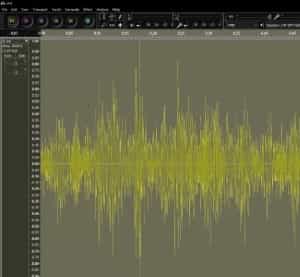
Audio waveform
After a number of experiments using microphones and radio hiss, none of which was particularly successful, I decided to try electronically generated white noise. This has the advantage of ruling out the possibility that a microphone may pick up a distant voice, or that stray radio signals may intrude into the between-station hiss (critics have suggested both possibilities). Rather to my surprise, I obtained immediate results.
Both the above samples were taken from a one-minute recording. In addition, throughout this minute of recording, there were sounds that resembled background chatter, although most of this was unintelligible. Furthermore, the procedure does seem to be replicable. So that you can try out the method for yourself, here are the technical details of the procedure that I followed.
Using a digital audio editor (Audacity), I generated 60 secs of white noise (sample rate 44100 Hz, mono, 32-bit float). This produced very faint suggestions of a voice, but too indistinct to make out any words.
I then decided to transform the recording using the editor's noise reduction facility (I found that minimum noise reduction was best). After this, I performed frequency filters for the range of voice frequencies (a High Pass Filter at 300 Hz, and a Low Pass Filter at 3000 Hz). Finally, I performed a Bass Boost at 1500 Hz to amplify the mid-range voice frequencies. As mentioned above, this produces an audio stream that has indications of background "chatter". In several places, there were snippets that suggested specific words or phrases.
To reduce file size before uploading these snippets, the sample rate was converted from 44100 to 8000 and files were saved in Windows PCM 16-bit format (wav). This conversion has led to a small decrease in sound quality, but the voices are still easily recognisable.
Audacity, the sound editor I used, is an excellent FREE open source cross-platform program. You should note, however, that the white noise generator in this software always produces identical data. This means that you can generate the actual audio stream that I used to produce the two voice snippets above ("Programming" is at about 5.4 sec and "You want the dollars" at about 58 sec. To produce a different stream, generate a longer period of white noise and then select a different segment.
If you want to experiment with EVP, the software can also be used to import your own recordings (e.g., using the recording methods mentioned at the start of this article). You can then try out various transform effects, (e.g., ampification, frequency filters and boosts, noise reduction.
For those who wish to experiment to true random white noise, an excellent free generator (based on atmospheric noise) is provided by random.org. The white noise can be downloaded to a file which can then be imported into an audio editor.
Comments
Electronic voice phenomena have not been widely studied by parapsychologists, who have generally been quite sceptical of the whole procedure.
In addition to the criticisms mentioned above, it has been argued that the voices are simply subjective intepretations - that we tend to hear voices in random patterms of sound rather in the way that we often see faces in random visual patterns such as clouds.
The suggestion is that because of the significance to humans of speech and facial recognition, the human brain has an in-built tendency to create these perceptions even when there is no "objective" basis for the experience. For others, however, the Raudive Voices are genuinely mysterious, even paranormal. Some even believe they open up the possibility of communication with the dead.
Further Study
Books and Articles
Bender, H. (1972). The phenomena of Friedrich Jürgenson. Journal of Paraphysics, 6, 65-75.
Ellis, D. (1975). Listening to the 'Raudive Voices'. Journal of the Society for Psychical Research, 48, 31-42.
Konstantinos (2004). Speak with the Dead: Seven Methods for Spirit Communication. Llewellyn Publications.
Parsons, S.T. & Cooper, C.E (2015). Paracoustics: Sound & the Paranormal. White Crow Books.
Raudive, K. (1971). Breakthrough: An Amazing Experiment in Electronic Communication With the Dead. Taplinger.
Smith, E.L. (1974). The Raudive Voices - objective or subjective? Journal of the American Society for Psychical Research, 68, 91-100.
Smyth, F. (1981). The ghosts in the machine. The Unexplained, 2(20), 398-400.
Smyth, F. (1981). Whispers of immortality. The Unexplained, 2(21), 418-420.